
Summary
Proofreading is a final quality check before content is published. At this stage, only minimal and necessary amends should be made.
Why amends need to be minimal
- Further amends can introduce new errors and will require more checks.
- Substantial changes to the messaging, narrative flow and style would result in rewriting the entire piece. This means a final, final proofread
- Making sweeping changes can cause delays in publishing content and increase cost, as more time is needed.
Pro tips
- Look at the overall structure first – layout, headings and so on.
- Then home in on the sentence-level detail. Read aloud, slowly and carefully.
- Remember the 3C’s
- Clarity – is it clear, jargon-free and written in plain English? Could someone with little or no knowledge of the subject understand?
- Coherence – does the message of the copy make sense with the other assets or visuals?
- Consistency – learn our A–Z house style guide
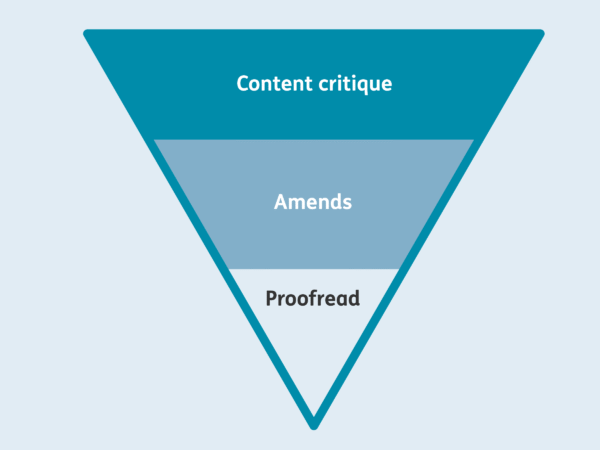
Content process
Amount of changes
The content critique stage allows us to check content aligns with the brief, business and user needs, tone of voice, and brand guidelines.
Readability, user experience (UX) should also be considered at this stage.
The content designer/producer shares their work early on before they get too attached to their creation.
Proofreading checklist
Grammar and Spelling
- Check for typos, e.g., missing words.
- Check grammar and spelling.
- Check there aren’t any extra spaces.
- Check that there aren’t any missing full stops.
- Check for missing apostrophes.
- Check for rogue spaces between words.
- Check for British spelling, e.g., ‘organisation’ rather than ‘organization’.
- Check for commonly confused words like ‘practice/practise’ or ‘effect/affect’.
- Check use of dashes (hyphen vs. en dash). For digital, consider using ‘to’ instead of an en dash for accessibility.
Consistency
- Check consistency of quotes.
- Check bullet point lists – ensure the bullet style is consistent with Tearfund’s style guide, and end-of-line punctuation is consistent.
- Check consistency of font, spacing, colour, and size.
Formatting
- Check formatting and headings.
- Check use of capitals.
- Check use of italics.
- Check alignments and indentation.
- Check that there aren’t any widows and orphans (single lines and words from a paragraph that appear isolated at the beginning or end of a column or page, or form an awkwardly short final line.)
Details and accuracy
- Check that numbers one to ten are written as words, but numbers greater than ten are written as numerals, e.g., ‘Bernadette sold five cows’, ‘our local partner worked with the community to supply 200 mosquito nets.’
- Check dates.
- Check that links work and direct users to the correct landing page.
- Check email addresses, phone numbers, and physical addresses.
Clarity and style
- Look for vague and ambiguous language, e.g., ‘support.’ What does ‘support’ mean? Suggest an amendment to clarify the meaning.
- Look out for ‘banned phrases’, e.g., ‘the poor,’ and suggest an acceptable alternative.
- Look out for clichés and ‘Christian-ese’, e.g., ‘God placed a burden on my heart for….’
- Check for verb/noun disagreement:
- ❌ ‘The news hasn’t arrived yet. They are usually here by lunchtime.’
- ✅ ‘The news hasn’t arrived yet. It is usually here by lunchtime.’
- Suggest replacing passive voice with active voice where possible to make it clearer who is doing what, which will make the copy more persuasive and trustworthy:
- ❌ Passive voice: ‘Many meals are provided to those in need by the food bank.’
- ✅ Active voice: ‘The food bank provides many meals to those in need.’
Readability and flow
- Check the need for a paragraph (one topic per paragraph).
- Check that captions agree with the image.
- Check for too many consonants, e.g., ‘asssociate’.
- Check for inappropriate word breaks.
- Look for repetition and saying the same thing twice over in different words, e.g., ‘She wandered aimlessly through the vast and expansive desert.’
- However, repetition might be used intentionally to add emphasis, e.g., ‘We need a plan, we need action, and we need it now!’ (Here, ‘need’ is repeated to emphasise the urgency of the situation.)
Have any questions?
For all content-related questions, please contact emma.lawson@tearfund.org